Slab Leak vs Sewer Line Leak
A leak under your home can cause real damage long before you see it clearly. Damp floors, cracks, bad smells, and slow drains can all point to a hidden problem. But they do not tell you which pipe is at fault.
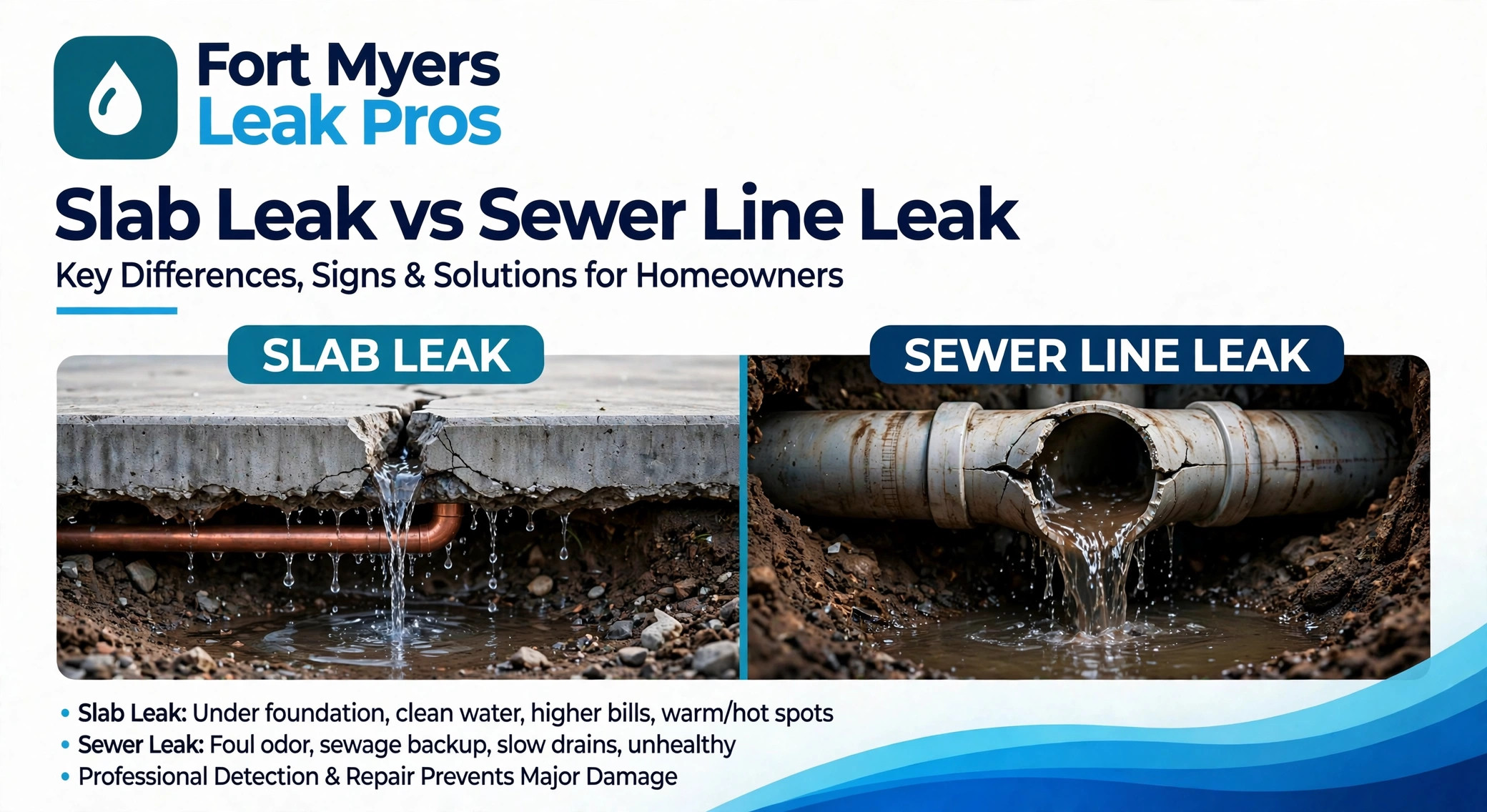
This guide will help you tell a slab leak vs sewer line leak apart in simple terms. You will learn the key differences, the signs to watch for, and what to do first if you suspect either problem.
What Each Leak Actually Is
A slab leak is a leak in a water supply pipe that runs below the concrete slab foundation of your home. These pipes carry clean water to your kitchen, bathrooms, and other fixtures. When one breaks, clean water can escape under the concrete, soak into the soil, and show up somewhere else in the house.
Common causes of slab leaks include pipe corrosion from age or water chemistry, which can thin copper pipes and create pinhole leaks. Abrasion can also wear a hole where a pipe rubs against concrete or gravel over time. High water pressure puts constant stress on joints, and shifting soil or foundation movement can bend or break a buried line. Poor installation or low quality materials can make a pipe fail sooner.
A sewer line leak is different. Your sewer line is the large drain pipe that carries wastewater away from toilets, sinks, showers, and other drains to the city main sewer. A leak here involves sewage, not clean water, so the health risk is higher and the signs are often more obvious once waste starts to escape.
Sewer line damage is often caused by tree root intrusion, where roots enter through a small crack or joint and grow inside the pipe. Severe clogs from grease or improper flushing can also block the line. Older pipes made of cast iron or clay can deteriorate over decades, crack, or rust. Ground shifting can misalign a pipe and open a gap where sewage leaks out and soil gets in.
In short, a slab leak is a supply problem, and a sewer line leak is a drain problem. One brings water in, the other takes waste out. That one difference explains many of their different signs.
Slab Leak vs Sewer Line Leak at a Glance
| What to compare | Slab leak | Sewer line leak |
|---|---|---|
| Type of water | Clean supply water | Wastewater and sewage |
| Pipe location | Water lines under the concrete slab | Drain line to the city main sewer |
| Common signs | Unexplained increase in water bill, running water when faucets are off, warm spots on the floor, damp carpets and warped flooring, low water pressure | Multiple drains slow or clogged at the same time, sewage smell or rotten egg smell, gurgling sounds from toilets or drains, lush patch of grass in the yard |
| Signs both can share | Cracks in foundation, walls, or ceiling, and foundation movement from soil that has been washed away or softened | |
The table shows why these leaks are easy to mix up. Cracks and foundation movement can come from either one, because both can change the soil that supports your home. The clearer clues are usually the water bill, warm spots, and running water sounds for a slab leak, and sewage smells, gurgling drains, and several slow drains at once for a sewer problem.
How to Work Out Which Problem You Have
Start with what you are actually seeing, hearing, and smelling, not with a guess about the pipe. A few questions can narrow it down quickly.
- Is your water bill up with no change in use, and do you hear running water when faucets are off? That points more to a slab leak.
- Do you smell sewage, hear gurgling, or see several drains backing up at the same time? That points more to a sewer line problem.
- Is there a warm spot on the floor? That points more to a hot water line under the slab.
- Is one patch of grass much greener and lusher than the rest of the yard? That can point to a sewer leak feeding that area.
- Are floors damp or warped, but drains are working normally and there is no sewage smell? That points more to a slab leak.
You can also do a few simple checks without opening floors or drains. Turn off all faucets, toilets, washing machines, dishwashers, and irrigation, then watch the water meter. If the meter keeps moving, water is still flowing somewhere in the supply system. Check whether the problem affects one fixture or many drains at once. Note when the signs started, and whether they are getting worse.
If the signs point both ways, do not force a decision yourself. A slab leak and a sewer problem can exist in the same home, and a plumber can test each system separately. The goal at this stage is to gather clear information, not to start digging.
How Plumbers Confirm the Difference
Plumbers do not need to guess, and they do not need to open a large area to start. They use different tools for supply lines and drain lines, which is another reason the two problems are treated separately.
For a suspected slab leak, professional slab leak detection in Fort Myers often starts with electronic listening devices. These sensitive microphones listen for the hiss or spray of water escaping under concrete, and a skilled technician can follow that sound toward the leak. Pressure testing is another key step. A plumber can isolate a section of pipe, fill it with air, and watch a pressure gauge. If the pressure drops, that section has a leak.
For a suspected sewer problem, a sewer camera inspection is usually the clearest test. A plumber finds a cleanout, which is an access point to the sewer line, and feeds a waterproof camera on a flexible cable into the pipe. The live video shows tree roots, cracks, blockages, collapsed sections, and the exact location of the problem. That video also helps decide whether a repair can be trenchless or needs excavation.
Other checks may support these tests, such as a meter test for a supply leak or a drain test for a sewer blockage. A good inspection should end with a clear answer about which system is leaking, where it is leaking, and what repair options fit that location.
What Repair Looks Like for Each Leak
Slab leak repair depends on where the leak is, what the pipe is made of, and whether it has leaked before. Spot repair is the most direct option. The floor is opened at the one located spot, and that small section of pipe is repaired. Because detection can be precise, the opening can be kept small.
Repipe or reroute is another option. In this case, the old leaking pipe is left in the slab and a new line is run through walls or overhead to serve the same fixtures. This avoids a new opening in the slab and can make sense when the old line is hard to reach or has leaked before. Epoxy pipe lining is a trenchless option for some slab lines. A liner coated with epoxy is placed inside the old pipe, inflated, and hardened to form a new pipe inside the old one.
Sewer line repair has its own modern options. Trenchless pipe lining works in a similar way, sealing a damaged section from inside without a long trench across the yard. Pipe bursting is another trenchless method. A new pipe is pulled through the old pipe, and a bursting head breaks the old pipe apart as the new pipe takes its place. Traditional excavation is still needed in some cases, especially if a pipe has collapsed or is severely damaged and cannot be lined or burst.
The right method is not chosen by preference alone. It depends on the pipe material, the extent of the damage, access to the line, and whether the problem is in one spot or along a long section. A clear detection result makes that choice much easier to understand.
What to Do First, and What to Avoid
If you suspect either leak, act promptly, but do not rush into digging or covering the damage. A calm first response protects both your home and your health.
- If sewage is backing up into the home, limit use of toilets, sinks, and showers, and keep children and pets away from affected areas.
- If water is spreading, pressure has dropped sharply, or the meter is moving fast with everything off, turn off the main water valve if you know where it is and can do so safely.
- Write down when signs started, take photos of damp areas, cracks, or yard changes, and note any bill changes. That record helps the plumber and is useful if you need to speak with your insurance company later.
- Call a licensed plumber in Fort Myers and describe the signs clearly, including smells, sounds, bill changes, and whether many drains are affected.
Avoid mistakes that can make either problem worse. Do not ignore a sewage smell or repeated drain backups, and do not assume a damp floor will dry on its own. Do not dig into a slab or yard to find the leak yourself, and do not replace flooring or repaint a wall before the source is found, because the damage can return. Do not keep pouring grease down drains or flushing items that should not be flushed, since both can add to a sewer blockage.
Treat the situation as urgent if sewage is inside the home, water is pooling and spreading, cracks are widening quickly, or you have lost water pressure across the home. In those cases, do not wait days to get a professional opinion.
How to Lower the Risk of Both Leaks
You cannot prevent every leak, but routine attention can catch many problems early, before they become major repairs. The habits that help are simple and mostly about noticing change.
Watch your water bill for an unexplained increase, pay attention to water pressure, and check for warm spots, damp flooring, musty smells, and new cracks. Watch drains too. If several drains slow down together, if gurgling returns, or if a sewage smell appears, treat that as a warning sign, not a one-off nuisance. Check the yard for an unusually lush patch, sinking soil, or persistent wet areas.
A regular plumbing inspection and maintenance plan can also help. A plumber can check water pressure, look for early corrosion or deterioration, test lines when needed, and advise on tree roots near a sewer line. At home, avoid grease in drains, avoid flushing wipes and other items that do not break down, and do not plant large trees directly over a known sewer line route if you can avoid it.
A slab leak and a sewer line leak start in different systems, but they share one lesson. Early signs are worth checking, accurate detection comes before major work, and the right repair depends on finding the exact problem first.
FAQs
Is a slab leak a big deal?
Yes, it can become serious if left unchecked, because leaking water can damage flooring and weaken the soil under the slab.
Do plumbers fix slab leaks?
Yes, licensed plumbers detect and repair slab leaks, often using non-invasive tools to locate the leak before opening the floor.
Is it expensive to fix a slab leak?
The cost varies with the leak location, repair method, and any floor or water damage. Early detection usually keeps the job simpler than a leak found after major damage.
How to tell if a sewer line is leaking in a yard?
Look for one patch of grass that is much greener or wetter than the rest, a persistent sewage smell outside, or soil sinking in one spot. If you see these signs, call a plumber for a sewer camera inspection rather than digging yourself.