Slab Leak Repair Options: Spot Repair vs Reroute
Before Choosing: Confirm the Exact Leak Location
A slab leak repair starts with finding the leak, not fixing it. In a slab-on-grade home, hot and cold supply lines often run in or below the concrete slab rather than through accessible wall cavities. That makes the exact location important, because the repair method depends on where the failed section sits and how easy it is to reach.
A leak detection specialist can narrow the location using acoustic equipment, pressure testing, and sometimes thermal imaging, and early slab leak detection in Fort Myers helps confirm the exact section before any repair is chosen.
Before you compare options, get clear answers to three questions. Is this the first leak on this line, or has the same run failed before? What is the pipe made of, and how much of its expected service life is left? And do you want the fastest, least disruptive fix, or the fix that removes the greatest risk of a repeat leak? Every option below answers those questions differently.
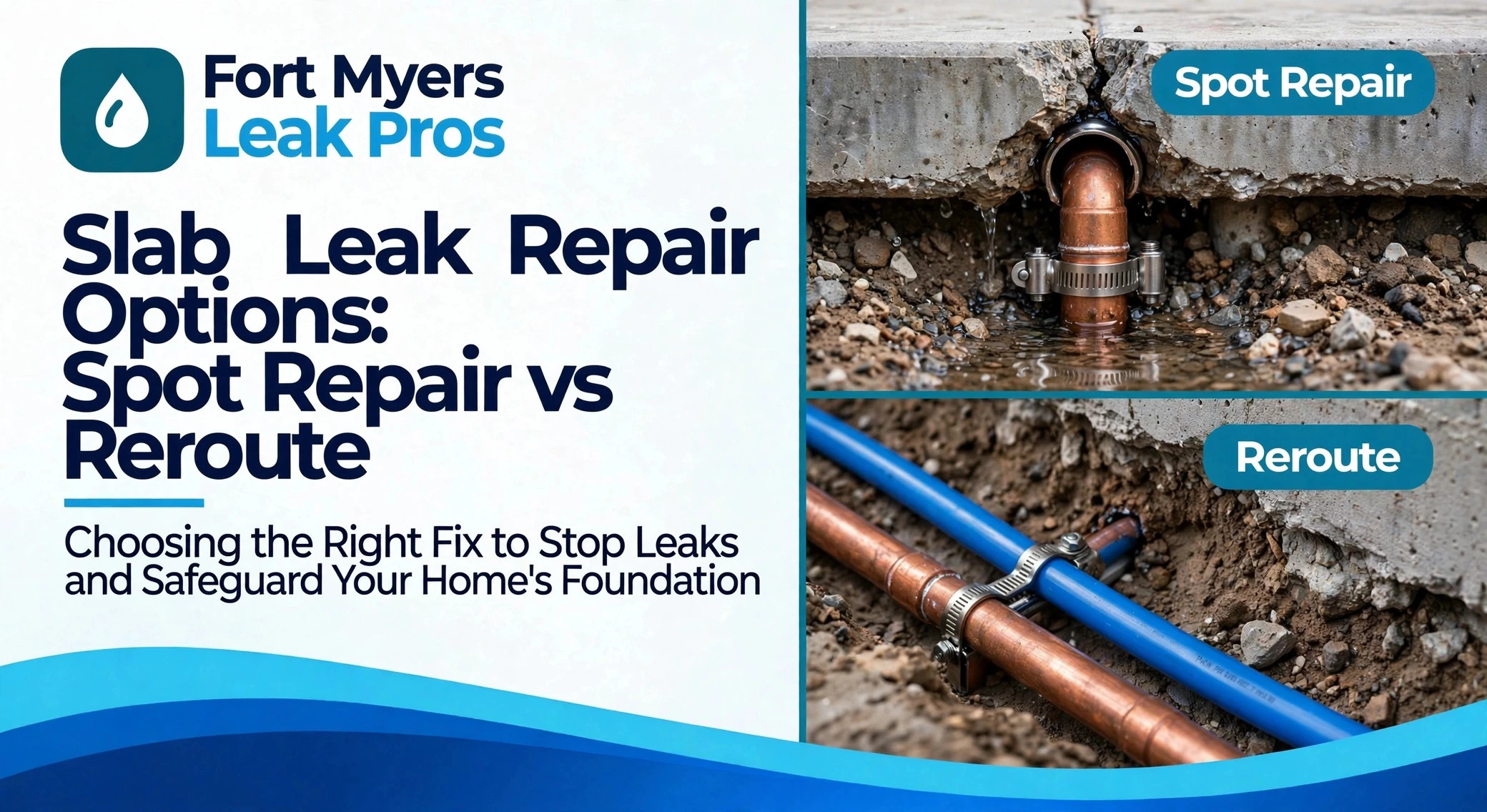
How Spot Repair Works
Spot repair means opening the exact failed section of pipe and fixing only that piece. The plumber usually cuts a small opening in the slab or wall directly above the leak, removes the damaged inch or two of pipe, and replaces it or sleeves it. The opening is then patched.
It is the least invasive of the slab leak repair methods. Only one access point is opened, and fixtures or pipe runs that are not part of the problem are left alone. That usually means a shorter repair timeline and minimal disruption to daily life.
Spot repair works best when the leak is truly isolated. For a home with newer pipe that has had one leak from a nick, a bad fitting, or a single point of damage, it can be a complete and lasting solution. It fixes the leak in front of you, and nothing else.
How Rerouting Works
A reroute takes a different approach. Instead of opening the slab to reach the damaged pipe, the plumber caps off the failed section at both ends and runs new pipe through an accessible path. That path is often through the attic, along an exterior wall, or along a baseboard, and it reconnects the same fixtures.
The old, leaking segment stays buried, but it is disconnected from the system. No cutting into the slab is needed for that section. This makes rerouting a strong option when the leak is in a spot that is hard to reach from below, or when you want to avoid opening flooring, tile, or foundation.
The new section also has a longer working life than the segment it replaces, because it is not buried in concrete and it is easier to service again if needed. A reroute is intended as a permanent fix for the specific line it addresses, not as a temporary patch for that line.
Spot Repair and Rerouting Side by Side
| Feature | Spot Repair | Reroute |
|---|---|---|
| What it addresses | The single leak location only | The failed line, rerouted around the damaged section |
| Invasiveness | Low, one access point | Low to moderate, no slab access needed |
| Typical timeline | Shortest of the options | Short to moderate |
| Prevents future leaks elsewhere | No | No, only on the line addressed |
| Best fit | One isolated leak in younger, otherwise sound pipe | A leak in a hard to reach spot, or a household avoiding slab access |
| Long-term durability | Depends on the remaining pipe condition | Strong for the section replaced, rest of system unchanged |
| Disruption to daily life | Minimal | Moderate |
The table shows why neither option is universally better. Spot repair is simpler and less disruptive, but it leaves the rest of the buried line untouched. Rerouting avoids the slab, but it still leaves every other buried run in place.
Why the Condition of the Rest of the Pipe Matters
Spot repair fixes exactly what it touches. If the pipe is aging and the leak is a symptom of broader deterioration rather than an isolated defect, spot repair buys time rather than fixing what is actually wrong with the line. A second leak in a different spot on the same run, a year or two later, is a common outcome when this method is used on pipe that is already failing broadly.
Pipe material and age narrow the choice quickly. Copper pipe that has failed once from a localized defect, a nick from installation, or a spot of aggressive soil contact is a good spot repair candidate, because the rest of the run is likely sound. Copper that shows pinhole leaks in multiple locations over a short span points to pitting corrosion that will keep producing new leaks, no matter how many individual spots are patched.
Older materials with known failure patterns change the math further. If a home still has original galvanized supply lines, thin-wall galvanized pipe, or an older generation of plastic pipe known for becoming brittle over time, a single leak in that material is rarely an isolated event. It is a sign that the rest of the system is on the same clock. Polybutylene pipe is another example of a material that can fail broadly rather than at a single weak point.
Age matters even when the leak looks isolated. A twenty-year-old system that develops its first leak is at a different point in its service life than a five-year-old system with the same complaint. That difference should weigh into whether a spot repair is a genuine fix or a stopgap before the next call.
Floor, Wall, and Restoration Differences
The two options differ most in where the work happens in your home. Spot repair concentrates the work in one place. The opening is usually in the floor or wall above the leak, and restoration focuses on patching that one area, including the concrete, flooring, or tile that was opened.
Rerouting spreads the work along a new pipe path. It avoids slab cutting, but the new pipe may need to pass through walls, ceilings, or attic spaces. That can mean patching drywall or ceiling penetrations in several places along the route, even though no single room is opened as deeply as in a slab cut.
In simple terms, spot repair is concentrated disruption in one spot. Rerouting is lighter disruption spread along a route. Which feels less disruptive depends on your home. A tile floor that is hard to match may make slab opening a bigger concern, while a long reroute through finished ceilings may make wall and ceiling patching a bigger concern. Ask how each option would look in your specific home before you decide.
When Neither Option Is Enough on Its Own
Sometimes neither spot repair nor rerouting addresses the real problem. A whole-home repipe replaces all of the supply lines, not just the section that leaked. Old pipe, wherever it runs, is abandoned in place or removed, and new pipe is installed through walls, attic spaces, and crawl areas rather than beneath the slab.
It is the most invasive option by a wide margin. It touches every room with a fixture, takes considerably longer, and usually requires patching in multiple locations afterward. It also removes slab leaks from the equation almost entirely going forward, since the new supply lines are not buried in concrete anymore.
A repipe makes the most sense when the evidence points to systemic failure, not an isolated incident. That includes multiple leaks that have already occurred, pipe material known to fail early or broadly, or piping that has simply reached the end of its realistic service life. At a certain point, rerouting several lines individually starts to approach the scope of a repipe, and it is worth comparing the two directly rather than treating each leak as a separate, isolated repair.
A home with one isolated leak on otherwise sound, younger pipe does not need its entire system replaced to fix that one problem. In that case, a repipe would be overkill.
Choosing Between Spot Repair and Rerouting
Use the questions below to narrow the choice:
- Has this line leaked before, or is this the first leak?
- Is the pipe material known for widespread failure, or does the damage look isolated?
- How old is the system, and how much service life is likely left?
- Is the leak easy to reach, or would opening the slab cause major floor damage?
- Do you want the quickest fix, or the fix that best protects that line for the long term?
- If the same line leaks again in a different spot, would you prefer to have rerouted it now?
If the answers point to one isolated leak in sound pipe, spot repair is often the sensible first move. If the leak is hard to reach, if you want to avoid slab access, or if the failed section itself needs a longer lasting replacement, rerouting is often the stronger choice. If the answers point to recurring leaks, aging material, or a system near the end of its life, neither option alone may be enough, and a repipe discussion is warranted.
Checks Before You Approve the Work
Before work starts, confirm the details in writing so there are no surprises later:
- The exact leak location, and how it was confirmed
- Which section of pipe will be repaired or abandoned
- Why the recommended option was chosen over the other option
- What will be opened, cut, or removed, and what will be patched afterward
- What is included in restoration, and what is not
- What happens if another leak appears on the same line after the repair
- Whether a second opinion would help, especially if the recommendation is a full repipe
It is also worth checking your insurance position early, by asking your insurer what your policy covers, especially for resulting water damage. Coverage often depends on the policy and the cause, so do not assume a repair or related damage is covered until you have checked.
The best choice is rarely the cheapest or the fastest option in isolation. It is the option that matches the leak, the pipe, and your long-term plans for the home, and that you understand clearly before any work begins.
FAQs
What is the most effective way to repair a slab leak?
There is no single most effective way for every home. Spot repair works best for one isolated leak in sound pipe, rerouting works best for a hard-to-reach or failing section, and a repipe is best when leaks keep recurring across an aging system.
Can you reroute plumbing in a slab foundation?
Yes, a reroute is made for slab foundations. The failed buried section is capped at both ends, and new pipe is run through an accessible path, such as an attic or along a wall, to the same fixtures.
How much does it cost to reroute plumbing lines in slab foundation?
The cost varies with the length of the reroute, the pipe path, the number of fixtures, and the restoration work needed. Ask for a written breakdown that shows what is included, rather than relying on a single quoted price.
Will homeowners insurance pay for a slab leak?
It depends on your policy. Some policies cover resulting water damage but not the cost of repairing the pipe itself, so check with your insurer and keep photos and reports.