How to Read Your Water Meter to Check for a Leak
Your water meter is the most honest witness in your home. It does not guess, and it does not care where the leak is hiding. Learning how to read it takes about five minutes, and the 15-minute test below can confirm a hidden leak before you spend anything on detection.
This guide covers where to find your meter, how to read both analog and digital models, and exactly how to run the leak test step by step.
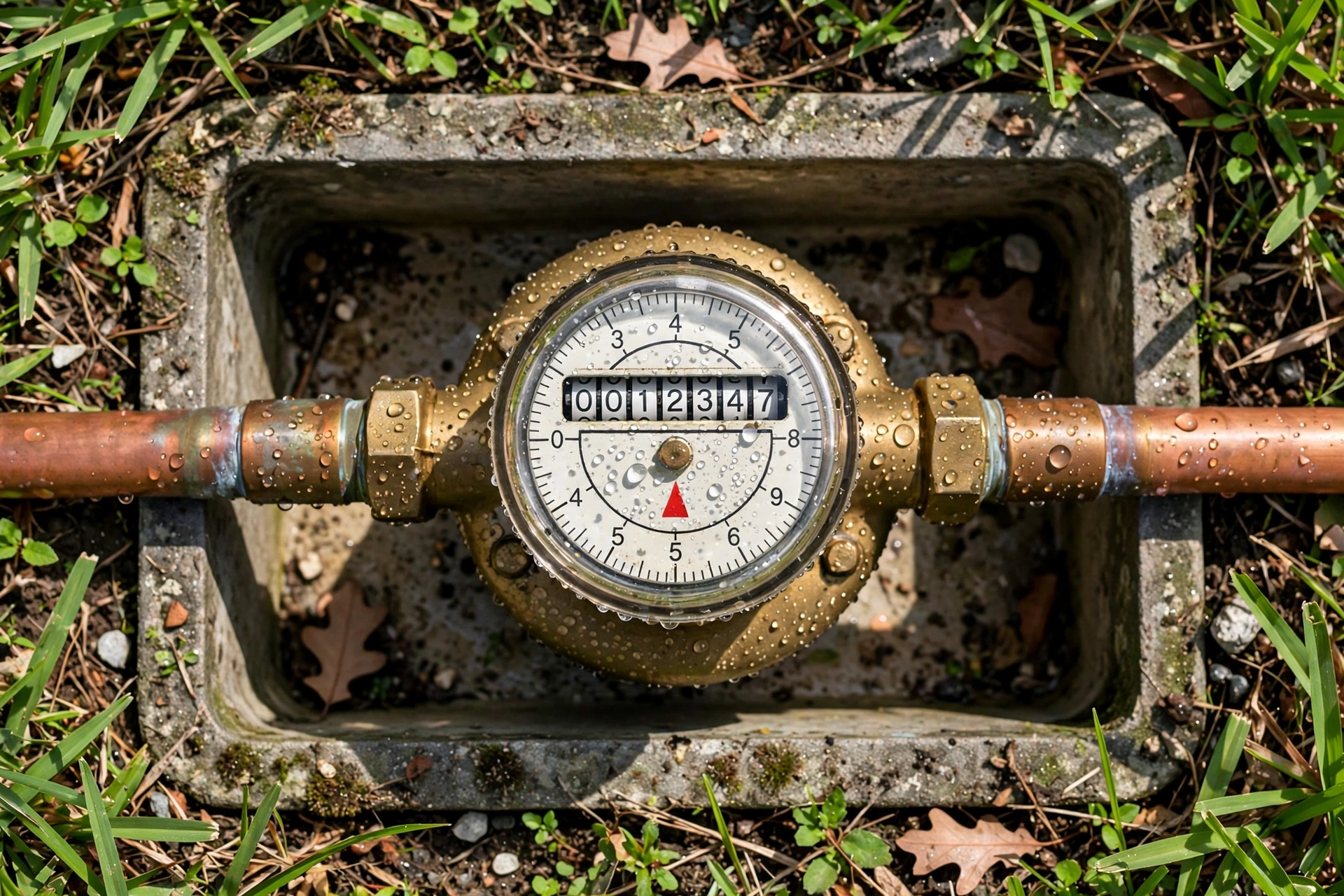
Where to find your water meter
In most Fort Myers neighborhoods, the water meter sits in a concrete or plastic box at the edge of your property, near the street or sidewalk. Look for a rectangular lid, often marked "water" or "meter." Lift it with a screwdriver or a sturdy stick, and set it aside carefully.
Two practical warnings before you open it. First, meter boxes in Florida collect rainwater, dirt, and insects, including fire ants, so wear gloves and look before you reach in. Second, wipe the meter face clean. Years of grime can hide the dials or the digital display completely.
How to read an analog water meter
Analog meters have a row of odometer-style numbers and one or two round dials. The numbers show total usage, and the large sweep hand measures small amounts as water flows. What matters for leak checking is the small leak indicator: usually a red triangle, a small star, or a tiny gear near the dials.
That indicator is extremely sensitive. Even a slow drip from a toilet flapper will make it turn. When no water is running anywhere in the house, it should sit perfectly still.
One note on units: some meters measure in gallons, others in cubic feet. Either is fine for leak checking, because you are watching for movement, not calculating volume. Your water provider's bill will tell you which unit they use if you are curious.
How to read a digital water meter
Digital meters show the reading on an LCD screen instead of dials. The screen usually cycles between total usage and current flow rate. Look for a flow indicator on the display: it may appear as a small faucet icon, a flashing plus sign, or a leak symbol, depending on the model.
With everything in the house turned off, the flow rate should read zero and the leak indicator should be off. Any flow showing on the screen means water is moving through the meter, which means it is going somewhere.
How to do the 15-minute leak test
This is the test referenced across our water leak detection pages. It works on any meter, analog or digital:
- Turn off everything that uses water. Every faucet, toilet, shower, dishwasher, washing machine, and ice maker. Do not forget the irrigation system: switch the controller to off, not just to a non-watering day.
- Open the meter box and clean the meter face. Note the current reading, or simply focus on the leak indicator.
- Watch the leak indicator for movement. On an analog meter, watch the red triangle or star. On a digital meter, watch the flow rate or leak icon.
- Wait 15 minutes without using any water. Make sure nobody flushes, runs a tap, or starts an appliance during the test. For a very slow leak, extend the wait to 30 minutes.
- Read the meter again. Compare the numbers, or check whether the indicator moved from its original position.
If the indicator moved or the numbers changed, water escaped through your plumbing during those 15 minutes. That is a confirmed leak, even if you cannot see a single drop anywhere.
What the results mean
The meter moved. You have a leak somewhere in the pressurized plumbing: a supply line, a slab line, a hidden pipe in a wall, or an irrigation main. The next step is narrowing down where, which is what professional leak detection does with acoustic and thermal equipment.
The meter did not move, but your bill is high. The leak may be intermittent. A worn toilet flapper leaks only when the tank refills, and irrigation breaks only run on watering days. Try the toilet dye test next, then check the irrigation zones one by one. Our high water bill guide walks through the full checklist.
The meter did not move and the bill is normal. Your pressurized lines are holding. If you still see dampness, it may be groundwater, condensation, or a drain line issue rather than a supply leak.
What to do if the test confirms a leak
First, do not panic, and do not start opening walls. A confirmed meter test tells you a leak exists, not where it is. Guessing at the location is how small leaks turn into big repair bills.
Second, you can narrow it down one step further with the main shutoff test. Your home has a main shutoff valve, usually where the line enters the house. Close it, then watch the meter again. If the meter stops, the leak is inside the house. If it keeps moving, the leak is in the buried line between the meter and the house, which points to underground leak detection.
Third, call for professional detection. Acoustic listening finds pressurized line leaks, thermal imaging traces hot-water lines, and moisture mapping shows dampness through walls, all without tearing anything open first.
Frequently asked questions
Where is my water meter located?
Usually in a concrete or plastic box near the street or sidewalk at the edge of your property, under a lid marked "water" or "meter." In some communities the box sits in a utility easement along the side of the lot.
What is the small red triangle on my water meter?
That is the leak indicator. It is designed to detect even tiny flows, so it will turn with any water movement at all. When everything in the house is off, it should be completely still.
How long should I run the meter test?
Fifteen minutes is enough for most leaks. For a very slow leak, such as a worn toilet flapper, extend the test to 30 minutes. The longer you wait, the more obvious a slow leak becomes.
My meter moves but I cannot find any water. What now?
That is normal for hidden leaks: slab lines, pipes inside walls, and buried service lines leak where you cannot see them. Run the main shutoff test to learn whether the leak is inside or underground, then call for professional detection instead of opening walls at random.
Can a running toilet make the meter move?
Yes. A toilet with a worn flapper or a stuck fill valve draws water around the clock, and the meter's leak indicator will turn. The dye test is the fastest way to confirm a toilet as the source before looking elsewhere.
Should irrigation be off during the test?
Yes, completely off at the controller, not just between watering days. Irrigation is one of the most common causes of a moving meter, and leaving it on makes the test meaningless.